
Over 700,000 Graduates Out of Work
Why Early Career Direction Can’t Be an Afterthought
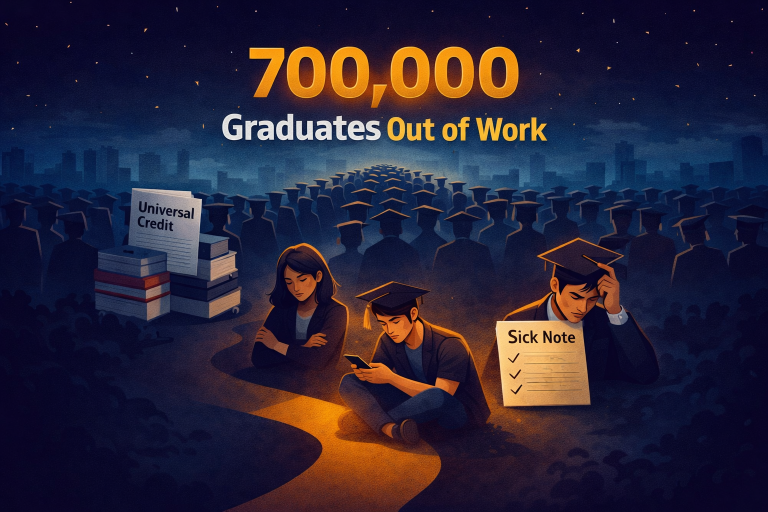
The BBC recently reported that more than 700,000 graduates in the UK are currently out of work and claiming benefits, a sharp rise since 2019.
Read the BBC coverage here: https://www.bbc.co.uk/news/articles/c1klry2rjm0o
At first glance, this looks like a graduate employment problem. A tough labour market. Fewer opportunities. The wrong degrees.
But when you look closer, the issue runs deeper.
This is not a failure of graduates.
It is a failure of direction.
Graduates Aren’t Unemployable
They’re Unclear
Most graduates are capable. Many are motivated. A large proportion still want to work and contribute. Yet growing numbers are becoming stuck between education and employment.
The BBC report highlights that around 400,000 graduates are claiming Universal Credit, with a significant rise in those under 30. A large number also report being unable to work due to health reasons.
That matters, because long periods of uncertainty often lead to:
loss of confidence
disengagement from applications
anxiety around decision-making
When people don’t know where they’re going, even small choices feel overwhelming.
This is the gap the Early Career Pathfinder course was designed to address.
Many people are never shown how to make a career decision in the first place.
Not how to pick a job title, but how to understand what they are drawn towards, how to test ideas, and how to explain a direction they can trust.
We break this down in more detail in our guide: How to Choose a Career – What every young person should know, and every parent should read.

A Degree Explains What You Studied
Not Where You’re Heading
University does a good job of developing knowledge. What it does not consistently do is help people answer the harder questions, such as:
what kind of work actually suits me
what am I drawn towards and why
how do I explain my direction to an employer
A degree tells an employer what subject you studied. It does not automatically explain your motivation, your intent, or your future direction.
When graduates cannot articulate this, applications become vague, interviews feel uncomfortable, and rejection becomes more likely. Over time, momentum fades.
The Gap Between Education and Work
Most graduates are never shown how to bridge the gap between:
interests and opportunities
curiosity and commitment
study and aspiration
Instead, they are expected to “figure it out” once their course ends.
This often leads to guessing.
- Guessing which jobs to apply for.
- Guessing what sounds convincing.
- Guessing what they should want.
Guessing is exhausting. And eventually, many people stop trying.
The rise in graduate inactivity highlighted by the BBC should be read as a warning sign. Not that young people lack ability, but that they lack structured support to turn interest into direction.
Why Career Direction Has Become Essential
The modern job market expects early career candidates to explain themselves clearly. Employers increasingly look for people who understand:
why they are applying
how their experiences connect
where they want to go next
Without direction, even strong candidates struggle to stand out.
Career clarity is no longer a “nice to have”. It is essential for staying active, confident, and engaged.
The Role of Early Career Pathfinder
Early Career Pathfinder was built to address this exact problem.
It provides a clear, guided way to:
understand what you are genuinely drawn towards
explore career ideas without pressure
build meaningful attachments to opportunities
shape a clear, believable next step
It is short, focused, and designed to help you move forward, not overwhelm you with options.
Instead of asking, “What job should I do?”, Pathfinder helps you answer: “What direction makes sense for me right now, and how do I move towards it?”
When direction is clear, confidence follows. Action becomes easier. People keep moving.

👉 Explore Early Career Pathfinder here:
Start the Early Career Pathfinder short course
Why This Matters Now
The BBC figures show what happens when career direction is left too late. At scale, it becomes inactivity. Individually, it becomes doubt and delay.
Career direction should not be an afterthought. It should be part of how people transition from education into work.
Early Career Pathfinder exists so fewer people become part of that statistic.